No consumer dispute appears out of thin air. They all start as complaints: a missed payout, an unexpected fee, or a refund request that gets ignored. How you handle that initial spark determines whether you put out the fire, or end up facing an ombudsman referral or a court date.
In our guide to Alternative Dispute Resolution in the UK, we looked at what happens once a disagreement has escalated. This article looks one step earlier: at complaints handling, the stage a business fully controls, and where most disputes can still be prevented.
This guide explains what good complaints handling looks like in the UK in 2026, the rules businesses must follow, and how NoLi Prevent helps compliance, legal and customer service teams resolve grievances fairly and quickly, before they ever reach an external body.
| Complaint (internal) | Dispute (external) | |
|---|---|---|
| Who decides | The business | An ADR body, ombudsman, arbitrator or court |
| Typical cost to the business | Staff time | Case fees, legal costs, management time |
| Control over outcome | High | Low |
| Reputational exposure | Private | Often reported to the regulator; sometimes public |
| Relationship with customer | Can be repaired and customer retained | Usually adversarial |
Put simply, every complaint resolved fairly at the first stage is a dispute that never needs resolving at all.
UK Complaints Handling Rules: The 8-Week Clock
In most regulated UK sectors, you have eight weeks to resolve a complaint before the customer takes it out of your hands. While specific rules differ across regulators, the core mandate is clear: resolve the issue promptly and fairly, or surrender control of the final outcome.
Gambling. Under the Gambling Commission’s Social Responsibility Code 6.1.1, licensees must have a complaints procedure, and the entire process should take eight weeks or less. If a dispute about a gambling transaction is unresolved after eight weeks, or the operator reaches a final position sooner, the operator must confirm this in writing and the customer can refer it to an ADR provider free of charge. Operators must also keep records of complaints and disputes and make them available to the Commission on request.
Financial services. The FCA’s Dispute Resolution: Complaints sourcebook (DISP) requires firms to send a final response within eight weeks. After that, the consumer generally has six months to refer the complaint to the Financial Ombudsman Service, whose decisions are binding on the firm if the consumer accepts them. The Consumer Duty adds a further expectation that firms deliver good outcomes and learn from complaint data.
Energy and telecoms. Ofgem and Ofcom rules follow a similar pattern: after eight weeks, or once the business issues a deadlock letter, the customer can go to the relevant ombudsman.
A changing ADR landscape. The Digital Markets, Competition and Consumers Act 2024 is replacing the ADR for Consumer Disputes Regulations 2015, moving accreditation of consumer ADR bodies to the Secretary of State. The Gambling Commission has updated its licence conditions to reflect this. The internal complaints stage is unaffected, but the stakes of getting it wrong are rising as regulators pay closer attention to complaint data.
The common thread: regulators are not only asking whether a business responded in time. They are asking whether the outcome was fair, consistent and properly reasoned, and whether the business can prove it.
Why Complaints Escalate
Most complaints don’t escalate into formal disputes because the business made a mistake. They escalate because communication broke down. When customers feel ignored, confused by a decision, or left waiting in the dark, a fixable issue quickly turns into a regulatory headache.
The most common causes are:
- Slow responses. Holding letters and silence push customers towards the eight-week deadline, at which point escalation becomes automatic.
- Inconsistent decisions. Two similar complaints handled by two different agents receive two different outcomes. Customers notice, and so do regulators.
- Weak reasoning. A final response that says “we have reviewed your complaint and are unable to uphold it” invites a challenge. One that explains the evidence, the relevant terms and the reasoning rarely does.
- Evidence scattered across systems. Transaction logs, chat transcripts, emails and account notes sit in different tools, so investigations are slow and incomplete.
- Over-stretched teams. Complaint volumes rise with growth, promotions and seasonal peaks; headcount rarely keeps pace.
Each escalation brings external case fees, management time, possible regulatory scrutiny and, often, a customer who will not return. The cheapest dispute is always the one prevented at the complaint stage.
What Good Complaints Handling Looks Like
Regulators and ADR bodies tend to judge a complaints process on the same five qualities:
- Accessible. Customers can raise a complaint easily, through any reasonable channel, and know what happens next.
- Prompt. Complaints are acknowledged quickly and resolved well within the eight-week window, not at the end of it.
- Evidence-based. Every decision is grounded in the facts: transaction records, communications, account history and the applicable terms.
- Fair and consistent. Similar complaints receive similar outcomes, and the reasoning would stand up if an independent body reviewed it.
- Documented. There is a clear audit trail showing what was considered, who decided and why, ready for the regulator or an ADR provider.
The challenge for most businesses is not knowing what good looks like. It is achieving it consistently, at volume, with a finite team.
What Is NoLi Prevent?
NoLi Prevent is NoLitigation’s AI-powered complaints and grievance handling platform, engineered to stop disputes before they start. Built strictly for internal compliance, legal, and customer support teams, it evaluates complaints against evidence and regulatory frameworks to ensure fair, rock-solid decisions. Consumers never log in; your team operates behind the scenes to deliver faster, clearer, and defensible resolutions.
How NoLi Prevent works
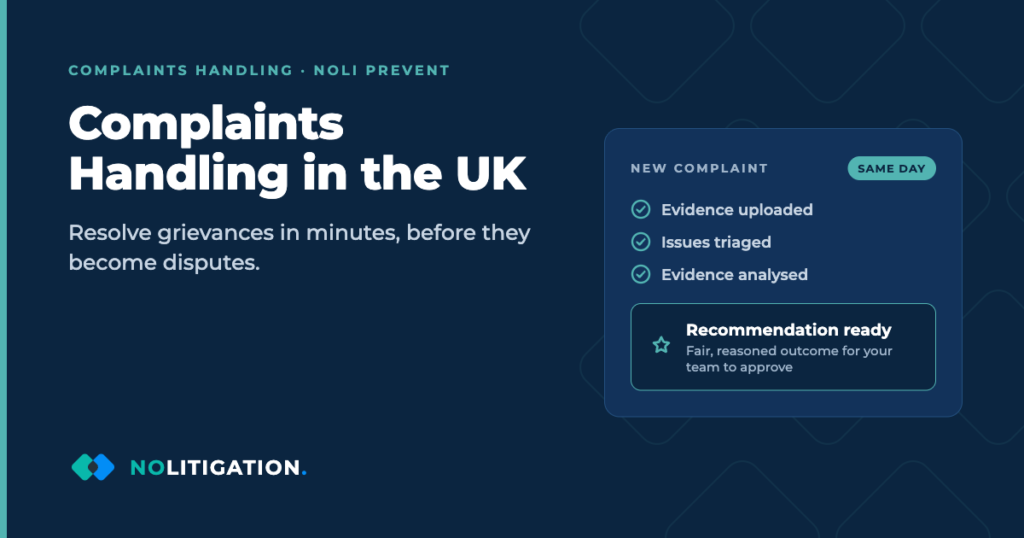
- Intake. A team member opens a case and uploads the complaint and supporting evidence: transaction records, chat logs, emails, account notes and the relevant terms and conditions.
- Triage. The platform organises the evidence and identifies the issues in dispute.
- Summary. NoLi Prevent produces a clear, neutral summary of the complaint, both parties’ positions and the key facts.
- Analysis. The AI reviews the evidence against the business’s terms, regulatory guidance and the applicable law, and tests how an independent reviewer would be likely to view the case.
- Recommendation. It proposes a fair, evidence-based outcome with its reasoning set out in full, together with a confidence score.
- Outcome. A human reviewer approves, adjusts or rejects the recommendation, and the final response is sent to the customer. The case is tracked through to acceptance.
What makes it different
- Human in the loop. NoLi Prevent recommends; your team decides. No outcome reaches a customer without human review.
- Reasoning, not just answers. Every recommendation shows the evidence relied on and why, so final responses are easier to write and harder to challenge.
- Consistency at scale. Similar complaints are assessed against the same standards, whichever team member handles them.
- A complete audit trail. Every step, document and decision is recorded, ready for the regulator or an ADR provider.
- Settlements on agreed terms. A recommended settlement only becomes binding if both the business and the customer accept it. For more on how this interacts with consumer law, see our article on the Consumer Rights Act 2015 and AI-generated settlements.
- Secure by design. Access is limited to the business’s own team, with two-factor authentication and single sign-on.
- Clear pricing. NoLi Prevent is priced per complaint, not by AI usage, so the cost of each resolution is visible from day one.
Complaints Handling in the Gambling Sector
Gambling is one of the most complaint-intensive consumer sectors in the UK, and one of the most closely regulated. That is why NoLi Prevent is launching with gambling operators first.
Typical gambling complaints include:
- Withheld or voided winnings
- Disputes over bonus terms and promotional offers
- Account closures, suspensions and restrictions
- Delays in withdrawals and access to funds
- Verification and identity checks
- Game or bet settlement errors
These complaints are evidence-heavy and term-heavy. Resolving them fairly means reading transaction histories, game logs and promotional terms side by side, then applying the Gambling Commission’s expectations on fairness and transparency. That is exactly the work NoLi Prevent is designed to accelerate.
For operators, the benefits are direct: fewer referrals to ADR, faster final responses well inside the eight-week window, more consistent decisions across the complaints team, and records that are ready whenever the Commission asks for them.
Complaints Handling in the Utilities Sector
Energy and water are among the most heavily scrutinized consumer sectors in the UK, operating under intense regulatory pressure from Ofgem and Ofwat. With tight margins and rising customer sensitivity around household bills, resolving grievances efficiently is critical.
Typical utilities complaints include:
- Billing accuracy and back-billing disputes: Unexpected balance changes, estimated meter readings, and historical charges.
- Direct Debit calculations: Sudden adjustments to monthly payment amounts.
- Switching and transfer delays: Issues arising during supplier transitions or mis-selling claims.
- Smart meter installations and functionality: Data sync errors, failed installations, and faulty hardware readings.
- Debt collection and payment arrangements: Disputes over affordability assessments and enforcement actions.
- Guaranteed Standards of Performance (GSOP) breaches: Failure to meet mandated service and appointment timelines.
These complaints are data-intensive and rule-heavy. Resolving them fairly requires cross-referencing consumption records, meter readings, and tariff structures against Ofgem’s Standards of Conduct and Ofwat’s customer protection rules. This is precisely the operational workload NoLi Prevent is built to streamline.
For suppliers, the advantages are clear: fewer escalations to the Energy Ombudsman or CCW (Consumer Council for Water), rapid final responses comfortably within regulatory deadlines, consistent decision-making across caseworkers, and audit-ready records whenever regulators inspect your files.
Complaints Handling in the E-Commerce Sector
E-commerce spans everything from physical retail marketplaces and digital subscriptions to luxury goods and direct-to-consumer (DTC) brands – all operating under strict UK Consumer Rights Act rules and high customer expectations. Rapid growth and complex logistics make complaint spikes inevitable across every segment.
Typical e-commerce complaints include:
- Physical Goods & Retail: Non-delivery, lost parcels, delayed shipping, damaged or defective items, and disputed return/refund policies.
- Digital Goods & Software: Subscription auto-renewals, digital download failures, access revocation, and software compatibility disputes.
- Luxury & High-Value Items: Authenticity disputes, condition mismatches, delayed high-value refunds, and transit insurance claims.
- Bespoke & Made-to-Order: Disagreements over customization specs, extended production delays, and non-refundable deposit disputes.
- Direct-to-Consumer (DTC) & Apparel: Fit/sizing discrepancies, minor cosmetic defects, and wear-and-tear vs. manufacturing fault claims.
- Marketplace & Third-Party Sellers: Platform seller disputes, missing payout releases, counter-fraud holds, and chargeback claims.
Resolving these complaints requires cross-referencing order histories, tracking data, terms of service, and consumer cancellation rights. NoLi Prevent accelerates this process by aligning case details against statutory rights and internal store policies.
For e-commerce brands, the benefits are immediate: fewer Section 75/ chargeback disputes, faster resolutions within statutory windows, consistent policy application across support agents, and complete audit trails for payment processors and legal teams.
Complaints Handling in the Travel & Aviation Sector
Travel is one of the most operationally volatile UK consumer sectors, regulated by statutory protections under UK Regulation 261 (UK261), the Package Travel Regulations, and oversight from the Civil Aviation Authority (CAA). From flight disruptions to holiday package changes, travel providers face high volumes of complex, time-sensitive claims where delays in resolution quickly lead to escalations.
Typical travel complaints include:
- UK261 statutory compensation: Claims for flight delays, cancellations, and denied boarding.
- Baggage and transit losses: Damaged, delayed, or lost luggage payouts under international conventions.
- Package holiday discrepancies: Mis-selling claims, itinerary changes, missing amenities, or breach of contract under Package Travel Regulations.
- Refund and cancellation delays: Disputes over non-refundable bookings, credit notes, or delayed statutory refund processing.
- Accessibility and passenger assistance: Complaints regarding reduced mobility services or failure to provide mandatory airport assistance.
- Extraordinary circumstance claims: Disagreements over whether weather, air traffic management, or technical faults negate compensation eligibility.
These complaints are heavily dependent on technical data and regulatory interpretation. Resolving them fairly requires matching flight logs, weather records, booking terms, and supplier correspondence against CAA guidelines, ABTA rules, and consumer law. NoLi Prevent automates this evidence-checking workflow.
For airlines, tour operators, and travel agencies, the commercial benefits are direct: fewer case referrals to CAA-approved Alternative Dispute Resolution (ADR) schemes (like AviationADR or CEDR) or ABTA arbitration, faster final decisions well within regulatory windows, consistent outcomes across global support teams, and fully documented, audit-ready records.
Complaints Handling in the Telecommunications Sector
Telecommunications is one of the highest-volume complaint sectors in the UK, operating under Ofcom’s strict General Conditions of Entitlement. With high customer sensitivity around connectivity, mid-contract price hikes, and service outages, broadband, mobile, and landline providers face constant operational friction where slow resolution directly triggers external escalations.
Typical telecom complaints include:
- Mid-contract price increases & early termination fees: Disputes over unexpected tariff hikes, out-of-contract rates, or exit fees when switching.
- Broadband speed & service reliability: Failure to deliver promised minimum guaranteed download speeds or unresolved line drops.
- Service outages & automatic compensation: Missed repair timelines, delayed initial provisioning, or disputed payouts under Ofcom’s Automatic Compensation Scheme.
- Billing errors & unexpected charges: Incorrect tariff application, roaming charge disputes, or unauthorized third-party billing additions.
- Porting & switching failures: Delayed number transfers (PAC code issues), loss of service during provider transitions, or erroneous transfers.
- Contractual mis-selling: Disagreements over promised hardware upgrades, bundled pay-TV services, or undisclosed term commitments.
Resolving these complaints requires cross-referencing telemetry data, line test logs, contract terms, and customer communication histories against Ofcom’s General Conditions and Automatic Compensation rules. NoLi Prevent automates this data-intensive verification process.
For telecom providers, the commercial impact is direct: fewer cases escalating to approved Alternative Dispute Resolution (ADR) schemes—such as the Communications Ombudsman or CISAS (CEDR) – faster final responses well within regulatory windows, consistent decision-making across customer service tiers, and audit-ready compliance records for Ofcom inspections.
How to Choose Complaints Handling Software
Many tools can log a complaint. Far fewer help you decide it correctly. When evaluating complaints management platforms, focus on these critical capability criteria:
- Decision support over basic ticketing: A generic case management tool tracks a complaint’s lifecycle, but it cannot evaluate whether a customer’s claim is valid. Look for systems that analyze underlying evidence and provide structured, reasoned outcome recommendations.
- Sector-specific regulatory alignment: The software must natively embed your industry’s regulatory framewor – whether that is Ofgem, Ofwat, Ofcom, FCA DISP, CAA, or Gambling Commission guidance; and actively enforce statutory resolution timelines like the eight-week clock.
- Explainability and defensibility: If AI is integrated into the workflow, every output must clearly cite its evidence sources and logic. A black-box recommendation offers zero protection during an ombudsman review or regulatory audit.
- Human-in-the-loop control: The platform must empower your compliance, legal, and support teams to retain full decision-making authority; accelerating their throughput rather than attempting to automate accountability away.
- Automated, inspection-ready audit trails: Every evidence document, procedural step, internal note, and final decision must be logged automatically to maintain continuous audit readiness.
- Predictable, per-complaint pricing: Outcome-aligned, per-case pricing models provide clear unit economics per resolution, avoiding the budget unpredictability of volatile usage-based AI metrics.
- Low-friction pilot adoption: Prioritize platforms that allow rapid proof-of-concept testing on historical or live cases, giving your team a clear, low-risk measure of operational lift before full deployment.
If you are looking for a platform that checks every one of these boxes, NoLi Prevent was designed specifically for your team. Built from the ground up to solve complex, regulated dispute workflows, NoLi Prevent equips your internal legal, compliance, and customer service teams with AI-powered decision support while keeping your experts fully in control.
By automating evidence analysis, embedding sector-specific rules, and generating fully explainable, audit-ready recommendations, NoLi Prevent helps you resolve grievances faster, protect your margins, and prevent complaints from escalating into costly external disputes.
Ready to transform your complaint handling operation? Contact NoLitigation today to schedule a demo or launch a low-risk pilot on your team’s recent cases.
The Future of Complaints Handling in the UK
Complaints handling is shifting rapidly from a reactive back-office task to a core strategic function. Key trends driving this transformation include:
- AI-assisted decision-making moves to core operations: AI co-pilots are expanding beyond experimental pilots into daily casework, with platforms like NoLitigation’s NoLi Prevent leading the shift toward specialized, sector-tailored decision support.
- Regulatory focus pivots to outcomes over timelines: Regulatory bodies are prioritizing decision quality and systemic conduct over mere clock-watching, analyzing complaint datasets to flag broader operational and compliance risks early.
- ADR framework reform under the DMCCA: Modernization of the UK Alternative Dispute Resolution framework under the Digital Markets, Competition and Consumers Act elevates the strategic importance of resolving disputes internally before they trigger external escalation.
- Surging customer demand for transparency: Modern consumers demand rapid, well-reasoned resolutions, leaving zero margin for vague denials or unhelpful form letters.
- Complaints as upstream intelligence: Forward-thinking firms extract insights from recurring complaint patterns to continuously refine products, clarify terms, and optimize service design before issues multiply.
The organizations that thrive will be those that treat every incoming complaint as a critical opportunity to deliver the right answer the first time.
Frequently Asked Questions (FAQs)
What is the difference between a complaint and a dispute?
A complaint is an initial customer grievance managed internally by the business. It escalates into a formal dispute when the issue remains unresolved after the internal complaints process, leading the customer to refer the matter to an independent external body, such as an ombudsman or Alternative Dispute Resolution (ADR) provider.
How long does a UK business have to resolve a complaint?
In most regulated UK sectors including gambling, financial services, utilities, and telecoms, businesses have an eight-week statutory window to resolve a complaint internally. Once this deadline passes, the customer gains the right to escalate the matter to an external ombudsman or ADR scheme.
What happens if a regulated business fails to resolve a complaint within eight weeks?
The business must issue a final response letter (or deadlock letter) confirming that the internal complaints procedure has concluded. The customer can then escalate the grievance to an accredited sector ADR provider or ombudsman at no cost to them.
What is NoLi Prevent?
NoLi Prevent is NoLitigation’s AI-powered complaints handling platform. It helps compliance, legal and customer service teams assess complaints against the evidence and recommend fair, evidence-based outcomes, so grievances are resolved internally in minutes before they become external disputes.
Does NoLi Prevent replace internal complaints teams?
No. NoLi Prevent operates strictly with a human-in-the-loop design. While the AI analyzes evidence and drafts reasoned findings, your team maintains full control and must review, edit, and approve every decision before it is sent to the customer.
Are recommendations generated by NoLi Prevent legally binding?
An outcome or settlement recommended by the platform only becomes legally binding if both the business and the customer formally agree to its terms. If a customer rejects the proposed resolution, they retain all statutory rights to escalate to ADR, an ombudsman, or court.
Do customers need to create an account or log into NoLi Prevent?
No. NoLi Prevent is strictly an internal, behind-the-scenes tool for your business’s support staff. Customers never log into a portal or interact with the software; they simply receive faster, clearer, and better-reasoned communications through your existing support channels.
Which sectors does NoLi Prevent support?
While launching first with UK gambling operators, NoLi Prevent is engineered to support all high-volume and regulated UK consumer sectors—including utilities, e-commerce, travel & aviation, and telecommunications.
How does NoLi Prevent handle different sector rules like Ofgem, Ofcom, CAA, or Gambling Commission guidelines?
NoLi Prevent embeds sector-specific regulatory frameworks, statutory consumer protection laws (such as the UK Consumer Rights Act and DMCCA 2024), and mandatory service standards directly into its decision engine. Every recommendation explicitly cites the exact legal terms, contract clauses, and evidentiary files used to reach a decision, while generating a full, automated audit trail to ensure every outcome is completely transparent, defensible, and ready for regulatory inspection.
Is AI decision-making compliant and explainable to regulators?
Yes. NoLi Prevent avoids “black-box” outputs by pairing every recommendation with explicit logic and direct references to submitted evidence and applicable rules. Every step is automatically logged into an audit trail ready for regulatory inspection.
How can my business test NoLi Prevent?
NoLitigation provides a low-risk proof-of-concept pilot using your team’s historical or active cases. You can request a live demonstration and initiate a pilot program by contacting the NoLitigation team today.
Conclusion
The UK has a well-developed system for resolving disputes, from ombudsman schemes to ADR and online dispute resolution. But the best outcome for a business and its customer is a complaint that never needs to go there.
Good complaints handling is prompt, evidence-based, consistent and well documented. Achieving that at scale, within the eight-week clock, is where AI can make the biggest difference.
NoLitigation is building the AI-native infrastructure for business dispute resolution. NoLi Prevent helps compliance, legal and customer service teams resolve grievances fairly and quickly, before they ever become a formal dispute.Request a demo to try it on your own complaints.